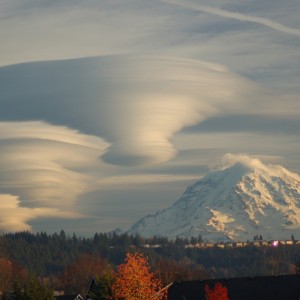
This post was inspired because I happened on this photo and thought, “This can’t be a real cloud. Must be a photoshopped flying saucer.”
Turns out this is a lenticular cloud and for people who live around certain mountains it’s relatively rare but not as surprising as it was to me.
My policy on this site is not to say anything I can’t understand myself. So after reading about 15 sites explaining how this cloud is formed, I still can’t say I understand. I do know these clouds look like they are stationary over the mountain. Actually they are air currents, which usually run horizontally, going vertically over a mountain and creating a pattern on the down-wind side that oscillates and forms clouds, then evaporates, then forms, in a wave pattern….or something. http://www.collthings.co.uk/2008/06/10-very-rare-clouds.html gives the best explanation of all kinds of clouds along with photos.
Next are Mammatus clouds.
Below are fallstreak clouds.
Guess what. It’s a wave cloud. Over Mt. Shasta, California
Also known as a kelvin-helmholtz wave cloud.
These roll clouds look ominous.
Above, a cousin of the roll cloud, a shelf cloud.
This is a super cell cloud. Yes, indeed.
More mean-looking storm clouds.
Friendlier weather.
Can’t talk about weather without lightening.
Lady Liberty takes a hit.
And a combo of our previous and next weather topic:
Now hurricanes
Hurricane Hugo, 1989–notice Florida
Hurricane Wilma, 2005, from higher satellite. Notice, Florida and the Gulf of Mexico.
After tornadoes and hurricanes, ice storms don’t seem so bad–but this was a bad one.
More ice than this tree could handle.
Thanks to the sites below for several images and explanations. Each offers many additional weather photos.
http://weatherpix.com/images.htm
http://cloudappreciationsociety.org/gallery/
http://www.collthings.co.uk/2008/06/10-very-rare-clouds.html
As always, when I could find a photo credit, I put it in with a link to the site.