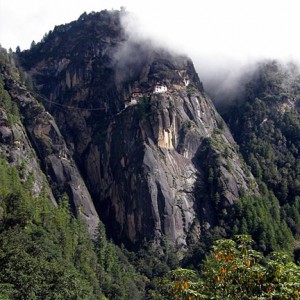
Ancient Buddhists in the East seem dedicated to constructing engineering feats.
Let’s start with the Tiger’s Nest Monastery in Bhutan.
This temple complex was first built in 1692, around a cave where a revered Guru Padmansambhanva is said to have meditated for three months in the 8th century. Padmasambhava is credited with introducing Buddhism to Bhutan.
The monastery buildings consist of four main temples and residential shelters designed by adapting to the rock (granite) ledges and eight caves. All the buildings are interconnected through steps and stairways made in rocks. There are a few rickety wooden bridges along the paths and stairways also to cross over. The temple at the highest level has a frieze of Buddha. Each building has a balcony, which provides lovely views of the scenic Paro valley down below.
Special permission is required for non-Bhutanese to visit the monastery, usually granted only to practicing Buddhists on a religous retreat.
Young monk peeks out of temple.
Next is The Hanging Temple or Hanging Monastery in China.
Built into a cliff (75 m or 246 ft above the ground) in Shanxi province , the Hanging Monastery was built more than 1,500 years ago.
The temple was constructed by drilling holes into the cliff side and inserting crossbeams halfway to serve as the foundation. How did they do this 1,500 years ago?
If you look carefully above, you will see somebody walking on this uninviting stairway.
Many thanks to fly_silence@163.com for photos of the Hanging Temple. If you want to see a video with music of these photos go here.
Next up: Popa Taungkalat monastery in Myanmar, formerly Burma.
Rising to 2,417 feet (737 meters) from the flat, surrounding plain, the Mt Popa Taugnkalat Monastery is built on the core of an extinct volcano last active 250000 years ago. At one time a Buddhist hermit, U Khandi, maintained the stairway of 777 steps to the summit of the pedestal hill named Taung Kalat. It is said the shrine is home to 37 Nats, or spirits, with statues depicting them at its base.
Above, a close up of the 777 stairs.
Now to central Java in Indonesia, and the 9th-century temple, Borobudur.
The monument comprises six square platforms topped by three circular platforms, and is decorated with 2,672 relief panels and 504 Buddha statues. A main dome, located at the center of the top platform, is surrounded by 72 Buddha statues seated inside a perforated dome. Some scholars think that this massive monument is a gigantic textbook of Buddhism. To read this textbook in stone requires a walk of more than two miles.
For more info on Borobudur go here. And thanks to Sacred Destinations for info and photos.
Back to Myanmar/Burma for Kyaiktiyo Pagoda also known as Golden Rock.
This small pagoda (7.3 metres (24 ft)) built on the top of a granite boulder is covered with gold leaves pasted on by devotees. According to legend, the Golden Rock itself is precariously perched on a strand of the Buddha’s hair. The rock seems to defy gravity, as it perpetually appears to be on the verge of rolling down the hill.
Now Tibet
Finally, Tongtian Avenue, in China is a long road cut along side the mountain to the tourist attraction of Tianmenshan.
This “Avenue” has exactly 99 turns. Heaven supposedly has 9 palaces.
Thanks to cousin Mike for the link that started this exploration of Buddhist Monastery wonders.