Karst Topography: from misty mountains to caves and sinkholes

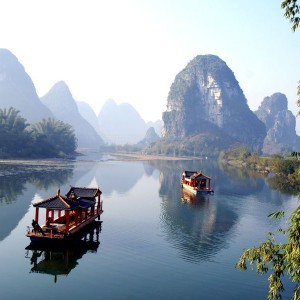
Karst towers, the rocky formations by the Li river in China near Guilin, are truly natural wonders.


By jacklee


By Karamochi


by bouti blog

Below is the town of Guilin.


By eric finlanson


Guilin rice harvest.

 The following image is so striking, I had to check to make sure it was real.  The story that goes with it makes it even more striking.   Here’s a description by photographer Michael Anderson at his website.  ” I wandered alone on the riverbanks and met a cormorant fisherman who showed me his traditional methods. They fish at night and the lantern attracts fish toward the raft so the cormorant can dive in and catch them. The fishermen tie a loose string around the cormorant’s neck so they can’t swallow it completely, and the men pull out the fish and store them in a basket. This method of fishing has existed for over a thousand years.

KARST TOPOGRAPHY

The Guilin tower karsts are an example of karst topography,  land formations caused by rainwater combining with carbon dioxide in the air to become slightly acidic.

The acidic water works its way into any crack, fault or fissure in limestone rock and chemically erodes the rock.  Over time, the openings caused by the acidic rain are widened into passages or caves and initial trickles of water become streams.  Sometimes the cave ceiling collapses forming  sinkholes or a cenotes.

The following are examples of the breathtaking variety of karst  topography from images taken around the planet.

Viet Nam, Halong bay

By steve vidler

Viet Nam

Viet Nam

By Paul Smit

Viet Nam

Viet Nam

Viet Nam

by Michael Buckley

Karst Forest, Madagascar

Via Flatrock.org

Haiti Karst

By Tequila Minsky

Bryce Canyon Karst, Utah


El Torcal de Antequera,  Spain

El Torcal de Antequera,  Spain

Shilin, South China

Akiyoshidai Karst pinnacles in Mine, Yamaguchi Prefecture, Japan

Mammoth Cave, Kentucky, U.S.A.

Mammoth Cave is the longest cave in the world, with over 350 miles explored so far.

 Corn karst, Chocolate Hills, Philippines

Australia, Nambung National Park

Sarisarinama sinkholes of Venezuela

Large sinkhole, Mitchell Plain, Indiana

 Sinkholes, Winslow, Arizona, U.S.A.

 The Zacatón cenote, Mexico

The “islands” in this cenote are made of floating reeds.

Thanks to Bukisa and DarkRoastedBlend

Architectural Oddities

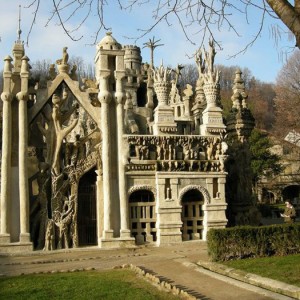
THE IDEAL PALACE

Ferdinan Cheval was delivering mail in April, 1879.  He tripped on a stone and  inspired by its shape, he started collecting stones.   For the next 33 years, Cheval carried stones from his delivery rounds and at home used them to build his Palais idéal, the Ideal Palace. First he carried the stones in his pockets, then a basket and eventually a wheelbarrow.

Cheval spent the first two decades building the outer walls. The Palace is a mix of different styles with inspirations from the Bible to Hindu mythology.  The stones are bound together with lime, mortar and cement. Cheval also wanted to be buried in his palace. However, since that is illegal in France, he proceeded to spend eight more years building a mausoleum for himself in the cemetery of Hauterives. Cheval died on August 19, 1924, around a year after he had finished building it, and is buried there.

For more info and photos go to oddity.

ELEPHANTE

Everything in Eliphante, a property in Cornville, AZ, USA is made from found materials.  The three acre site was created over 28 years by Michael Kahn and his wife, Leda Livant and includes a  residence, Hippodome, which has 25-foot ceilings and incorporates rocks and scraps from construction sites and a studio, one wall of which is the Ford pickup that brought the couple west.

Hippodome has electricity, heat, a phone line and water, but no bathroom or toilet. To wash, one goes across the property to the bathhouse, where the solar-heated shower is a length of chopped hose but the windows are stained glass.

Hippodome

Ceiling fan

The kitchen

For more info on Elephante follow this link to the New York Times.

The Mushroom House, Cincinnati, Ohio, USA

Another unique home made with found and used materials of wood, glass, tiles, and shells selected to make the building “look like it belonged in nature.  Terry Brown spent over 14 years building this home with the help of his architecture students.

The Ryugyong Hotel in Pyongyang, North Korea

NO, THIS IS NOT PHOTOSHOPPED.

This monstrosity is a testament to North Korea’s bizarre totalitarian leadership.  Construction began in 1987 and was designed to be 105 stories, have 3000 rooms, 7 revolving restaurants, casinos, nightclubs and Japanese lounges.  Originally scheduled to be completed in 1989, by 1992 construction was completely halted due to funding problems amid electricity shortages and famine.
Japanese newspapers estimated the cost was US $750 million, consuming 2% of North Korea’s GDP.

Even more strange,  the North Korean government denied the building’s existence for many years!  Though mocked-up images of the completed hotel had once appeared on North Korean stamps, the government manipulated official photographs in order to remove the structure, and excluded it from printed maps of Pyongyang.  Imagine denying this!

Stone House-Guimarães,Portugal

The Crooked House-Sopot, Poland

Low impact woodland house                     (Wales, UK)

Boeing-727 house in Benoit,Mississippi

This house cost Joanne Ussary $2,000, cost $4,000 to move and $24,000 to renovate.  The stairs open with a garage door remote and one of the bathrooms is still intact.  Check out the jacuzzi in the cockpit.

Bird Island Zero Energy Home (Kuala-Lumpur)


Cob-House-Vancouver-Canada

Cubic Houses (Kubus-woningen) Rotterdam, Netherlands

Earth house Dietikon Switzerland

Forest Spiral, Darmstadt, Germany

The Church of Hallgrimur Reykjavik, Iceland

The Piano House, Huainan, China

The old Mill House in Vernon, France

Cactus House Rotterdamn, The Netherlands

Dar al hajar house, Wadi Dhahr, Yemen

A House in a maze, Cordes sur Ciel, France

Hang Nga Guesthouse a.k.a Crazy House, Vietnam

Kansas City Library, Missouri

Lotus  Temple, Delhi,  India

Olympic Stadium Montreal, Canada

Shoe house Abel Erasmus Pass, Branddraai, Mpumalanga South-Africa

Spaceship house , Chattanooga , Tennessee

The Basket Building, Ohio, USA

Thomas Point Lighthouse, Maryland, USA

Guggenheim Museum, Bilbao, Spain

The National Library, Minsk, Belarus

Okinawa tree house at entrance to Onoyama Park

House Attack Viena, Austria

Outdoor sculpture at the Museum Moderner Kunst

For more details about many of these buildings go to weburbanist.

Thanks to Claire Elizabeth for inspiring this post.